Expanding Access, Rewarding Vision: Why Private Universities Must Be Part of Zambia’s Bursary Future

By Prof. Lubinda Haabazoka
I still remember the early days.
In 2012, while I was at the Copperbelt University (CBU), I began teaching at the University of Lusaka (UNILUS). At the time, the two institutions had a Memorandum of Understanding, and our operations were modest, based out of Kabendekela House near the Intercity Bus Terminus in Lusaka. It was a humble beginning, one that reflected both ambition and constraint.
Fast forward to today, and the transformation is nothing short of remarkable.
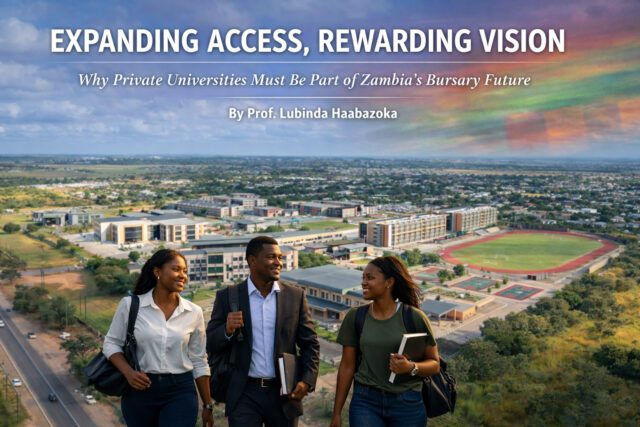
UNILUS has evolved into a modern institution with world-class infrastructure, including the newly commissioned Silverest Campus and Teaching Hospital in Chongwe District. This growth is not accidental. It is the result of deliberate vision, persistence, and leadership. Professor Pinalo Chifwanakeni has demonstrated, in very practical terms, how an idea can be nurtured into a thriving education enterprise that contributes meaningfully to national development.
This is why recent remarks by President Hakainde Hichilema are both timely and important. In commending UNILUS for complementing government efforts in the provision of quality education, the President acknowledged a fundamental reality: government alone cannot meet the growing demand for higher education.
Public universities have carried legacy challenges for decades, ranging from outdated facilities to funding constraints and operational inefficiencies. What is encouraging under the current administration is the willingness to confront these issues head-on. Timely responses to these legacy constraints signal a government that recognises the centrality of higher education to national development.
This balanced approach, strengthening public institutions while recognising the role of private universities, is exactly what Zambia needs.
Zambia’s youthful population continues to expand, and with it, the demand for university places. Public universities, despite their critical role, face capacity constraints. Private universities have stepped in to bridge this gap, absorbing thousands of students who would otherwise be left without access to higher education.
However, access without affordability remains incomplete.
The call by Professor Chifwanakeni to extend student bursary support to learners in private universities must therefore be taken seriously. This is not merely an institutional request, it is a national policy imperative.
At present, bursary schemes largely favour students enrolled in public universities. While this approach may have historical justification, it inadvertently creates inequity. A student’s access to financial support should not be determined solely by the type of institution they attend, but by their need, merit, and potential contribution to society.
If two students meet the same academic criteria but one is admitted to a public university and the other to a private institution, should the latter be denied support simply because of institutional classification? Such an approach risks entrenching inequality rather than alleviating it.
Extending bursaries to private universities would achieve several important outcomes.
First, it would expand access. More students, particularly from disadvantaged backgrounds, would be able to pursue higher education without financial barriers.
Second, it would promote competition and quality. When funding follows the student, institutions, both public and private, are incentivised to maintain high standards in order to attract and retain learners.
Third, it would deepen public-private partnerships in education. As President Hichilema rightly observed, collaboration is essential if Zambia is to meet its human capital development goals.
Fourth, it would maximise the return on existing infrastructure. Facilities like the UNILUS Teaching Hospital represent significant national assets. Ensuring they are fully utilised by a diverse student population enhances both efficiency and impact.
Of course, any extension of bursary support must be accompanied by clear accountability frameworks. Accreditation, quality assurance, and performance monitoring will be critical to ensure that public resources are used effectively. Institutions benefiting from such schemes must meet defined standards and demonstrate measurable outcomes.
But these are manageable challenges, not reasons for inaction.
It is also important to recognise excellence where it is due. The recent conferment of an Honorary Doctorate on President Hakainde Hichilema is well deserved. It reflects not only his leadership but also his commitment to education and national development. More importantly, it aligns with a broader policy direction that seeks to modernise infrastructure, resolve legacy challenges, and reposition Zambia’s higher education sector for global competitiveness.
The story of UNILUS is, in many ways, a story of Zambia itself, a country of ideas, resilience, and potential. From Kabendekela House to Silverest Campus, the journey illustrates what is possible when vision meets execution.
The next step is clear.
If we are serious about inclusive education, we must move beyond traditional boundaries and embrace a more integrated system, one where public and private institutions work together, supported by equitable financing mechanisms. Supporting government efforts to modernise public universities, while extending bursary access to private institutions, is not a contradiction. It is a complementary strategy.
Extending bursary support to private universities is not just about funding students. It is about investing in Zambia’s future.
And that is a cause worth supporting.